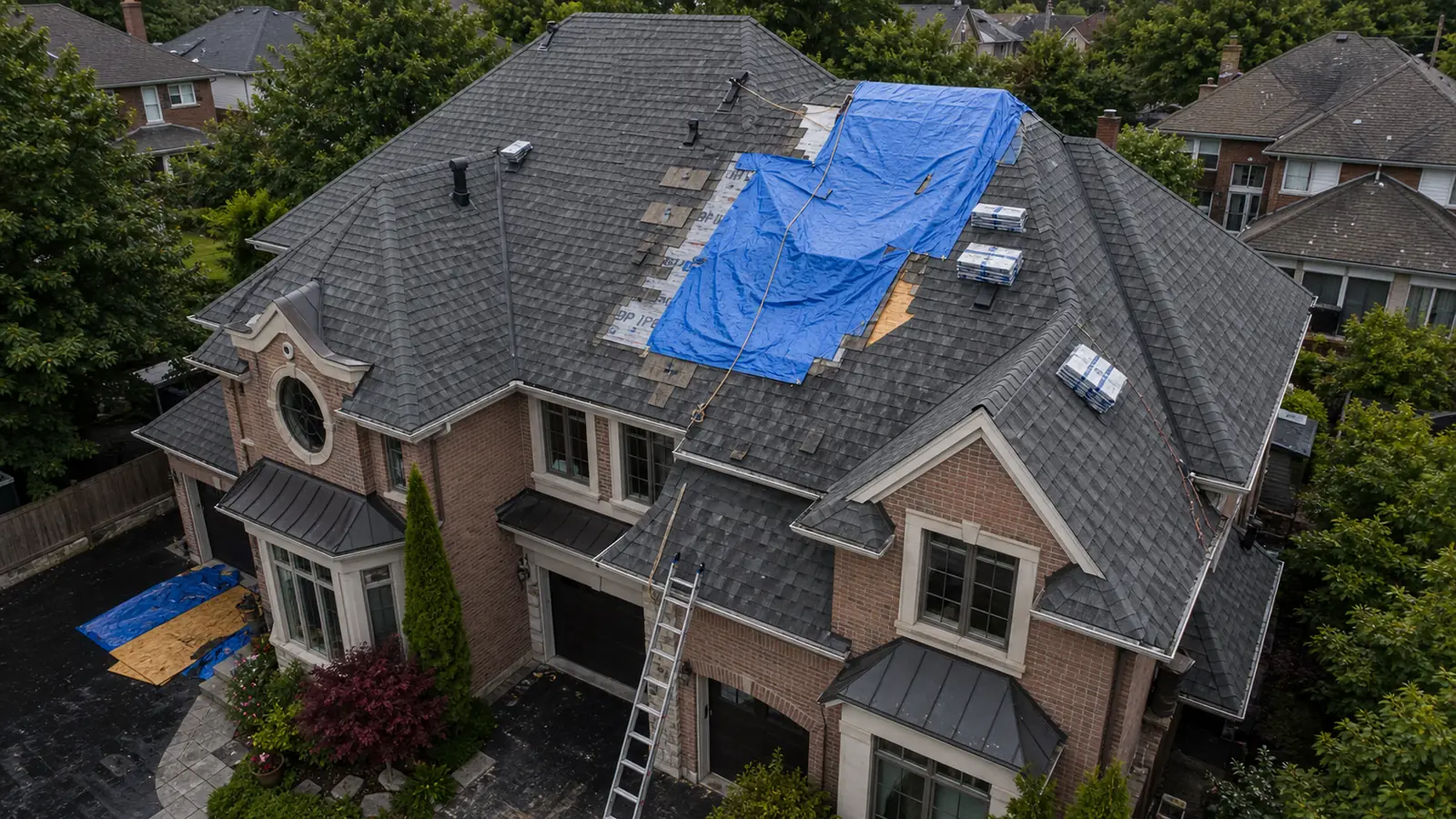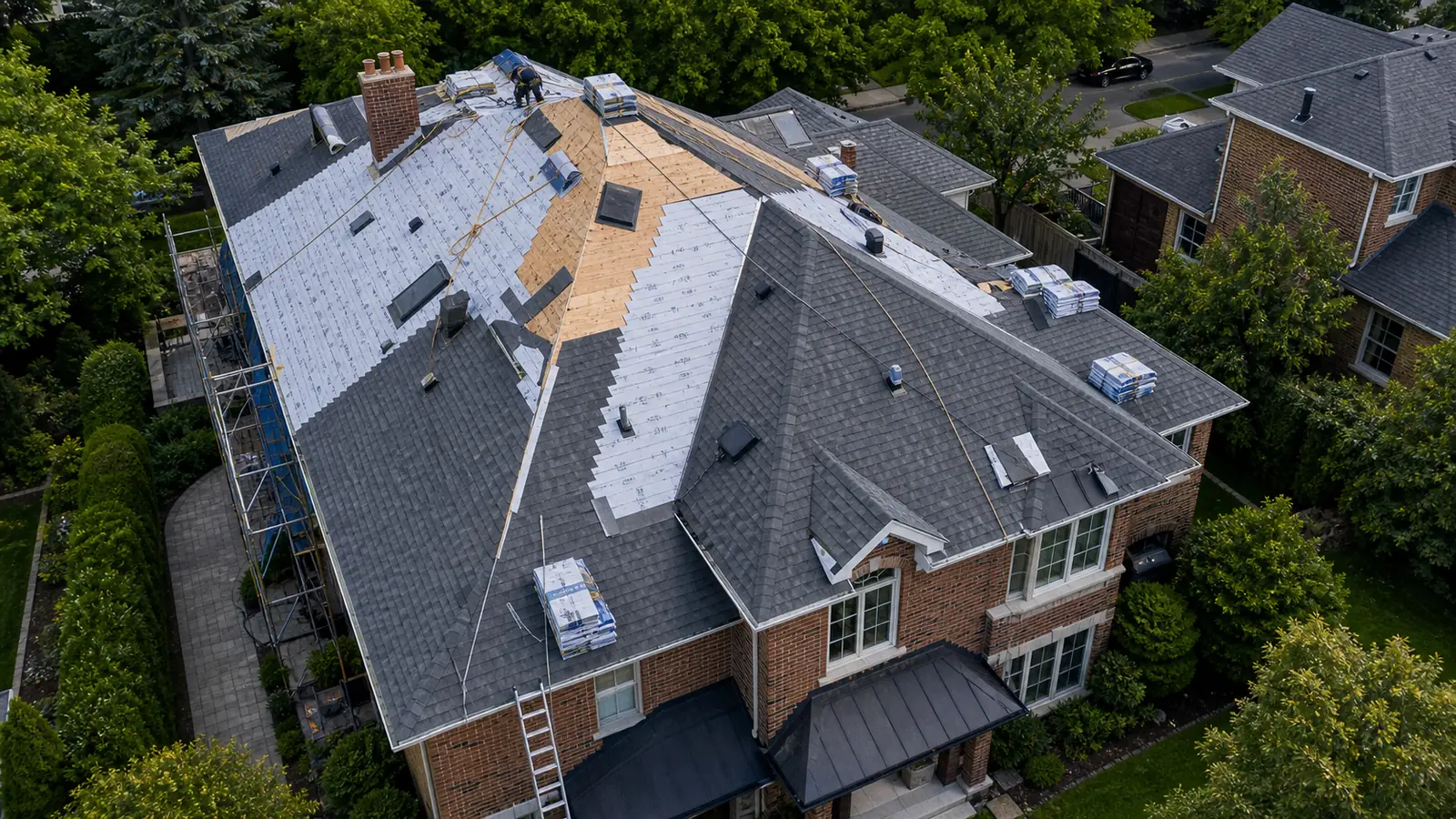
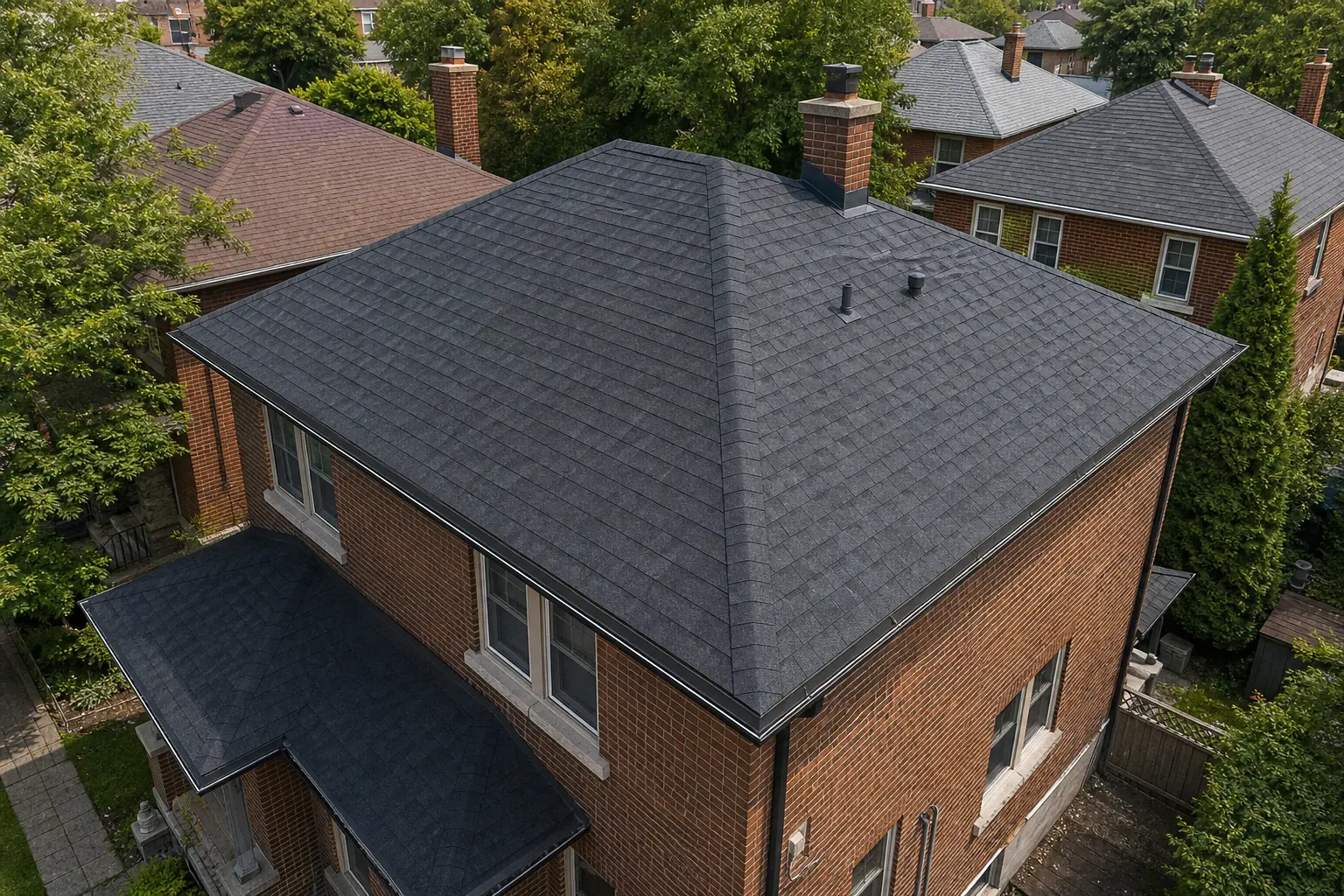
Why hiring the right Toronto roofer matters
Toronto roofs work harder than most. Forty-plus freeze-thaw cycles a winter, ice damming at eaves, summer UV that fades shingles in 15 years, and storm seasons that strip flashings. The result: a roof in Toronto needs the right install detail to last, and the wrong contractor turns a 25-year roof into a 12-year roof. By the time the failure shows up, the original installer is often gone, the warranty is impossible to enforce, and the homeowner pays twice.
The three checks below are the ones that prevent the most common bad outcomes. None of them are exotic. They are the basic professional standards every legitimate Toronto roofer already meets. The job is just verifying that the person standing in your driveway with a clipboard actually meets them before you sign anything.
Thing 1: Verify the licence, WSIB clearance, and local address
Toronto roofers operating legally hold three pieces of paper. A City of Toronto business licence issued by Municipal Licensing & Standards. WSIB clearance (Workplace Safety and Insurance Board) which is Ontario's mandatory workers compensation coverage. And commercial general liability insurance of at least $2 million, ideally $5 million. All three are easy to ask for and easy to verify.
How to verify a Toronto roofer's licence
Ask for the company's full legal name, the licence number, and the registered business address. Plug the licence number into the City of Toronto's online business licence search. The result tells you whether the licence is current, what classes it covers, and whether there are any active complaints or suspensions. A roofer working under a personal name with no registered company is not necessarily illegitimate, but it does make the next two verifications harder.
Why WSIB clearance matters in Ontario
WSIB clearance protects you, not the roofer. If an uninsured worker falls off your roof, your homeowner's insurance can deny the claim and the worker can sue you personally for medical costs and lost income. WSIB clearance certificates are issued for 90 days at a time and the certificate number can be verified directly at the WSIB clearance website. Ask for the current certificate, not a screenshot from two years ago. A roofer who has let WSIB lapse for "a few weeks" is a roofer you cannot afford to hire.
Commercial general liability: $2M minimum, $5M better
Commercial general liability insurance covers damage to your property — torn-up landscaping, broken windows, water damage during the install, neighbours' property if shingles end up on their car. Two million dollars is the legal floor in most Toronto roofing contracts. Five million is the standard for any roofer working on detached homes worth $1M+, which is most of Toronto now. The roofer carries a certificate of insurance from their insurer, and you should ask for it; their broker can email it within an hour if it is current.
Thing 2: Get a written, photo-backed quote
The single biggest source of roofing disputes in Toronto is scope ambiguity. The homeowner thinks they paid for X, the roofer says X was an extra, and there is no document settling the question. A proper written quote eliminates this by listing everything before any work begins.
What a proper Toronto roof quote includes
- Company information: Full legal name, address, phone number, licence number, WSIB number, and the name of the person quoting.
- Scope of work: Specific list of what will be done. "Roof repair" is not scope. "Replace 12 damaged 3-tab asphalt shingles on the south slope, re-flash the chimney with new step flashing and counterflashing, replace one cracked vent boot" is scope.
- Materials specified: The brand, product line, and colour. "IKO Cambridge Architectural Shingles, Driftwood colour, 50-year warranty" is specified. "Architectural shingles" is not.
- Fixed total price: Including HST, including disposal, including any access equipment. "From $X" is a sales tactic, not a price.
- Workmanship warranty: Length, what it covers, and what voids it. In writing on the quote itself, not "we'll discuss the warranty later."
- Payment schedule: When deposits are due and what the final payment is contingent on.
The role of photos in a quote
A photo-backed quote includes pictures of the actual roof areas being repaired or replaced. This serves three purposes: it confirms the roofer was actually on your roof, it documents the pre-work condition for warranty purposes, and it gives you something to compare against during and after the work. Roofers who quote off a description without ever climbing the ladder are guessing at the scope. The price is then guesswork too.
Red flags in a Toronto roof quote
- Verbal-only quotes or quotes texted from a phone number without a company email.
- "Time and materials" pricing on residential repair work. T&M is for emergencies or true unknowns, not routine work.
- Deposits of 30 percent or more before any work, or cash-only payment terms.
- Pressure to sign on the spot. A legitimate quote is valid for 14 to 30 days; if you are being pushed to commit immediately, the quote is not actually firm.
- Significantly lower price than all other quotes (more than 25 percent below). Something is missing from the scope or the materials.
Thing 3: Understand the workmanship warranty
Two warranties cover a new roof in Toronto. The manufacturer warranty on the shingles themselves comes from IKO, GAF, BP, Owens Corning, or whoever made the product; this typically runs 25 to 50 years and covers defective material. The workmanship warranty comes from the installer and covers errors in the installation itself — flashing leaks, nail pops, valley failures, ridge cap problems. These are different documents covering different problems.
Material warranty versus workmanship warranty in practice
Most Toronto roof failures in the first 10 years are workmanship issues, not material issues. Shingles last decades if the nailing pattern is right, the underlayment is properly lapped, the valleys are detailed correctly, and the flashings tie in properly. When a five-year-old roof leaks, it is almost never the shingle's fault. The workmanship warranty is the one that actually pays out claims in the first decade, which is why its length and terms matter so much.
What good Toronto workmanship warranty terms look like
- 10 to 20 years on a full replacement, written, transferable to the next homeowner if you sell.
- 1 to 5 years on a repair job, written into the quote itself.
- Covers labour and material for the warranty repair, not just labour with the homeowner buying replacement shingles.
- Clear inclusions: nail pops, sealing failures, flashing leaks, valley issues, ridge cap blow-off in standard winds, granular loss patterns that indicate installation problems.
- Reasonable exclusions: hurricane-force winds (over 110 km/h sustained), hail damage that triggers insurance claims, ice damming on roofs over a certain age, owner-caused damage. These are normal.
The most common warranty bait-and-switch
A roofer quotes a "50-year warranty" which is actually the manufacturer warranty on the shingles, while the workmanship warranty is buried in the small print at 1 year. The homeowner discovers this when a flashing leaks in year 3 and the roofer points to the fine print. The fix is reading the warranty document before signing and asking specifically: "What is your workmanship warranty in years, and what does it cover?" If the answer is not immediate and confident, the warranty is not real.
Bonus signs of a quality Toronto roofer
The three checks above prevent the worst outcomes. The signs below separate competent roofers from genuinely good ones.
- Local reviews are recent and detailed. Look for Google reviews from the last 12 months mentioning specific Toronto neighbourhoods, specific work types, and specific employees by name. Bot-generated reviews are vague and cluster on the same dates.
- They walk the roof during the inspection. A 30-second ground-level look is a sales call, not an inspection. Real diagnostic work happens on the roof itself, ideally with a moisture meter on flat sections and a photo report you receive afterward.
- They tell you when you do not need work. An honest Toronto roofer occasionally tells homeowners their roof has another 5 years left and walks away from the job. A roofer who quotes a full replacement on every house is a roofer to be cautious of.
- They explain the trade-offs. Architectural shingles versus 3-tab. IKO versus GAF. Full replacement versus repair with selective shingle replacement. A roofer who can articulate why one option fits your situation better than another is one who understands the work.
- They are easy to reach after the job. Cell number on the quote. Returns calls within a business day. Has been at the same Toronto address for at least 3 years.
Questions to ask a Toronto roofer before you sign
Print this list, take it to the meeting. The roofer's reaction to the list is as informative as the answers themselves.
- What is your City of Toronto licence number and can I see a copy?
- Can you email me your current WSIB clearance certificate?
- Can your insurance broker email me your certificate of insurance directly?
- What is the workmanship warranty length and what specifically does it cover?
- What is the manufacturer warranty on the shingles you are quoting?
- Can you show me three Toronto homes you have done in the last six months?
- Who is the actual crew foreman doing the work, and how long have they been with you?
- How do I reach you if there is a problem during the work?
- How do I reach you if there is a problem a year after the work?
- What is your deposit policy and your payment schedule?
Any roofer who cannot answer all ten of these in a 15-minute conversation is not a roofer you want on your roof. Any roofer who answers all ten clearly and provides documentation on requests 1 through 3 is a roofer worth getting a quote from. The next conversation, after that filter, is about scope and price — which is the easy part.
Frequently asked questions
01How do I check if a Toronto roofer is licensed?
Two checks. First, ask for the company name, business number, and the name on the licence; cross-reference at the City of Toronto Municipal Licensing & Standards business search portal. Second, ask for their current WSIB clearance certificate (provincial workplace insurance) and verify the number directly with WSIB. A legitimate Toronto roofer hands these over without hesitation. Hesitation, deflection, or "we are working on it" is a red flag.
02Should a Toronto roofer ask for a deposit before starting the job?
A small deposit (10 to 15 percent) on a roof replacement is reasonable to cover material ordering. A deposit of 30 percent or more before any work, or any deposit on a small repair, is a red flag. Reputable Toronto roofers invoice on completion for repairs and use staged payments tied to milestones on replacements. Never pay cash with no receipt and never pay the full balance before the work is finished.
03What should a written roof quote actually include?
Six things at minimum: the company name, address, and licence numbers; a clear scope of work (what is being repaired or replaced); the material brand and product line being used; a fixed total price (not "starting from" pricing); the workmanship warranty length and what it covers; and the payment schedule. Quotes that fit on a napkin or arrive as a text message are not quotes — they are sales pitches.
04How long should a roofing workmanship warranty be in Toronto?
The industry standard for a full roof replacement workmanship warranty in Toronto is 10 to 20 years, separate from the manufacturer warranty on the shingles themselves. For repairs, a 1 to 5-year workmanship warranty is normal. Anything shorter than these ranges, or warranty language that excludes the most likely failure modes (storm damage, wind, ice damming) is worth questioning before you sign.
05What if my Toronto roofer disappears or refuses to honour the warranty?
Three steps. Start with written documentation: send a registered letter describing the issue and the warranty claim. Escalate to the City of Toronto Municipal Licensing & Standards office and the Better Business Bureau if there is no response. For amounts under $35,000, the Ontario Small Claims Court is the practical recourse. Hiring a licensed contractor with a real Toronto address makes all three options easier; this is why we keep harping on the licence check at the start.
06Is the cheapest roofing quote usually the worst quote?
Almost always, yes, in our experience. The cheapest Toronto roofing quote is usually one of three things: an unlicensed installer cutting corners on insurance and overhead, a quote that omits scope (you will pay for the missing items as "extras" later), or material substitution (cheaper shingles installed than what was quoted). Quotes that come in 30 percent below the other quotes you receive almost always have a hidden cost waiting to surface during or after the work.